Disclosure: As an Amazon Associate, I earn from qualifying purchases. Learn more
Last Updated on November 13, 2026 by Mark Jase
Rust takes years to lock an engine, so the cure rarely comes in minutes. For most rust-seized engines, Kroil AeroKroil Penetrant is the first can to reach for, with B’laster PB Penetrating Catalyst as a strong all-round backup.
Picture a car, tractor, or mower that sat outside for a few seasons and now refuses to turn over by hand. Before you pull the engine apart, you want to know whether rust or real damage is the cause, how long to let the oil soak, and how to turn the crank without breaking a ring or a rod.
This guide covers the four penetrants worth your money, how to soak cylinders through the spark plug holes, and the signs that no amount of oil will help. That way you spend your weekend on the right fix, not on wishful spraying.
Kroil AeroKroil Penetrant creeps deep into rusted cylinders for long soaks, while B’laster PB Penetrating Catalyst leaves a lasting film for everyday frozen parts.
For Deep Rust Soaks

Kroil AeroKroil Penetrant
- Works into tight threads
- Cleans carbon deposits
- Pushes away moisture
For All-Round Shop Use

B’laster PB Penetrating Catalyst
- Non-evaporating lubricating film
- Automotive and marine use
- Breaks free frozen parts
How We Picked These Penetrating Oils for Engines
A seized engine is a tougher job than a rusty bolt. The fluid has to reach a stuck piston ring through a spark plug hole and keep working for hours or days, so we focused on products built for deep creep into tight gaps.
We compared what each maker lists about rust breaking, the film left behind, odor, and how the fluid is applied. A lasting lubricating or protective film mattered, because it keeps working between your attempts at the crank.
We also kept a mix of can sizes and nozzle styles. A large engine needs volume, while small engines and fasteners reward precise, low-mess spraying.
Our Top Penetrating Oil Picks for Stuck Engines
1. Kroil AeroKroil Penetrant for Deep Seized Engine Soaks
Kroil is made to work into small openings, tight threads, and crevices, which is exactly where rust locks piston rings to cylinder walls.
Beyond penetrating, the listing says it removes rust, cleans carbon deposits, and inhibits corrosion, and it holds up in high humidity and salt water. That makes it a solid first choice when an engine has been sitting outdoors or near the coast.
In-Use Impressions: It fits slow, patient jobs where you spray, wait, and come back to the wrench later.
Notable Features:
- Cleans carbon deposits as well as rust
- Rated for humid and salt water conditions
Core Strengths:
- Reaches deep into rusted threads
- Leaves corrosion protection behind
- Pushes moisture off metal
Works Well With:
- Seized pistons, bolts, and studs
- Chains, hinges, and garage door rollers
- Bikes and marine hardware
Good To Know: A 10 oz can goes quickly when you fill several cylinders. Plan on more than one can for a multi-cylinder engine.
2. B’laster PB Penetrating Catalyst for Rusted Engine Parts
If your toolbox needs one can for most rusted jobs, this is a strong candidate. It is made to break free rusted or frozen parts on automotive, industrial, marine, and plumbing equipment.
After it works in, a non-evaporating lubricating film stays on the parts to help prevent new rust. That film is useful on an engine you are freeing slowly over several days.
In-Use Impressions: It suits mechanics who reach for one penetrant across car, boat, and household repairs.
Notable Features:
- Non-evaporating film after application
- Listed for marine and plumbing use
Core Strengths:
- Keeps working between soak sessions
- Helps slow new rust
- One can covers many trades
Works Well With:
- Rusted exhaust and suspension bolts
- Outboard and marine hardware
- Stuck pipe fittings
Good To Know: The listing gives few details on odor or surface safety. Test it on painted or plastic parts before heavy use.
3. WD-40 Specialist Penetrant for Precise Rust Penetration
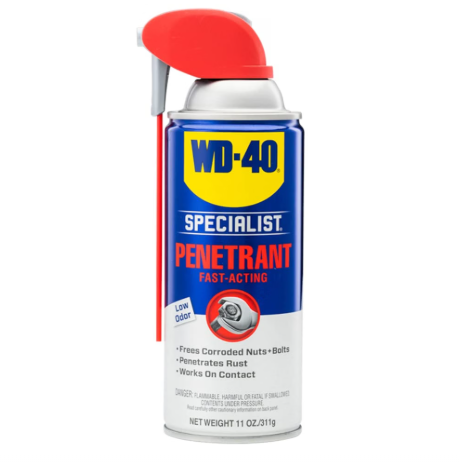
The Smart Straw sprays two ways, a narrow stream for threads and spark plug holes or a wide spray for large rusty areas. That control means less wasted fluid and less mess on the engine.
The formula is fast acting and low odor, built to break rust and corrosion and then leave a protective layer against new corrosion. It is a dedicated penetrant, separate from the classic multi-use spray.
In-Use Impressions: It works well when you need to aim fluid exactly where the rust is, with little overspray.
Notable Features:
- Two-way Smart Straw spray pattern
- Protective layer after it works
Core Strengths:
- Easy to aim into plug holes
- Low odor for long sessions
- Less overspray on nearby parts
Works Well With:
- Nuts, bolts, and threads
- Locks and chains
- Hard-to-reach engine fasteners
Good To Know: Do not confuse it with regular multi-use WD-40, which is a lighter general lubricant and water displacer.
4. Liquid Wrench Penetrating Oil for Light Rust and Bolts

For lighter rust and stuck fasteners, this smaller can does the job without a strong smell. The formula dissolves rust and cuts through grease to free nuts, bolts, and locks.
It is low odor with 0% VOC, listed as safe on painted surfaces, plastic, and PVC, and compliant in all 50 states. The listing names pipe fittings, clamps, and hose fittings among its top uses.
In-Use Impressions: It suits occasional repairs and small engines where a full-size can would be more than you need.
Notable Features:
- Safe on painted surfaces, plastic, and PVC
- 50-state compliant formula
Core Strengths:
- Gentle on nearby trim and plastic
- Handles grease along with rust
- Compact can stores easily
Works Well With:
- Lawn mower and small engine bolts
- Pipe fittings and clamps
- Locks, latches, and hinges
Good To Know: The 5.5 oz size is small for soaking a seized car engine. Treat it as a companion can for fasteners.
What Causes an Engine to Seize in the First Place
Most engines that seize while parked do it slowly. Moisture gets into a cylinder through an open valve, a missing spark plug, a damaged air filter, or condensation, and rust bonds the piston rings to the cylinder wall.
Other engines seize while running. Low oil, overheating, or a failed bearing can weld moving parts together under heat and load. That type of seizure is a different problem from rust, and penetrating oil rarely fixes it.
Debris is a third cause. Rodents, leaves, or broken parts inside a cylinder can jam a piston, and no amount of spraying will clear a solid object.
| Seizure type | Likely cause | Penetrant helps? |
|---|---|---|
| Seized while parked | Rust from moisture | Often, with time |
| Seized while running | Low oil or overheating | Rarely |
| Hydro-locked | Water or fuel in cylinder | No, remove liquid first |
| Jammed by debris | Foreign object inside | No, remove debris |
When Penetrating Oil Will Not Save an Engine
It helps to be honest about the limits before you buy a single can. Penetrating oil works on rust and corrosion, not on broken metal or heat damage.
- Seized from oil starvation. When bearings overheat from lack of oil, the clearances are gone. A rebuild or replacement is usually the real fix.
- Water sitting in a cylinder. Liquid cannot compress, and forcing the crank can bend a connecting rod. Remove the water first.
- Debris inside the cylinder. Look through the spark plug hole with a light or inspection camera before you soak anything.
- Deep pitting on the cylinder walls. Even if the engine frees up, heavy rust damage can leave poor compression.
If the engine still will not move after repeated soaks over a week or more, plan on removing the cylinder head to look at the pistons directly.
Why Penetrating Oil Creeps Where Regular Oil Cannot
Engine oil is too thick to slip into the tiny gap between a rusted ring and a cylinder wall. A penetrating oil uses a thin, low-viscosity carrier that wicks into microscopic spaces through capillary action.
Once inside, the fluid wets the rust, weakens its grip, and leaves a thin film of lubricant between the metal surfaces. Time is the main ingredient, because the fluid moves a little further into the joint with every hour it sits.
This is why repeated light applications often work better than one heavy dose. Each new layer carries fresh fluid deeper while the earlier layer keeps softening the corrosion.
Ingredients That Separate Good Penetrants From Weak Ones
Most penetrating fluids combine a few types of ingredients, even though exact recipes are kept private. Knowing the roles helps you read a label.
Low-viscosity solvent. This is the carrier that creeps into threads and gaps. It also evaporates over time, which is why some products need reapplication.
Lubricating oil. A lighter oil stays behind after the solvent leaves, so the parts can slide once the rust lets go.
Corrosion inhibitor. Many products add an inhibitor or protective film to slow new rust on the freed surfaces.
Propellant. Aerosol cans add a propellant to push the fluid out. It adds speed and reach, but it also makes the spray flammable.
Features That Matter in a Rust Penetrant Spray
Once you know the basic chemistry, a few practical features decide which can works best for your engine.
- Creep and film. Look for a product that lists deep penetration and a lasting film, which helps over multi-day soaks.
- Nozzle control. A straw that switches between a narrow stream and a wide spray makes it easier to aim into spark plug holes.
- Can size. A multi-cylinder engine can use a full can in one soak, so larger sizes save trips to the store.
- Odor and VOC level. Low-odor formulas are easier to live with during long sessions.
- Surface safety. Check whether the label says it is safe on paint, plastic, and rubber parts near the engine.
Going by the listed specifications, the smallest pick here is labeled low odor with 0% VOC and safe on painted surfaces, plastic, and PVC, which is useful when you are working around trim and hoses.
Choosing Between Kroil PB Blaster WD-40 and Liquid Wrench
All four brands free rusted parts, but each has a slightly different strength. Match the can to the job rather than buying on name alone.
| Product | Main strength | Best match |
|---|---|---|
| Kroil AeroKroil Penetrant | Deep creep, carbon cleaning | Long cylinder soaks |
| B’laster PB Penetrating Catalyst | Non-evaporating film | Everyday rusted parts |
| WD-40 Specialist Penetrant | Two-way Smart Straw | Targeted spraying |
| Liquid Wrench Penetrating Oil | Low odor, 0% VOC | Light rust and fasteners |
For a seized diesel engine, the same soaking method applies, but diesel cylinders are larger and the compression is higher, so plan on more fluid and more patience. For general shop use beyond engines, our roundup of everyday penetrating oils covers more options.
Does WD-40 Work as a Penetrating Oil
Yes and no. Classic multi-use WD-40 is a water displacer and light lubricant. It can loosen mild rust, but its thin film is not built for long soaks on a seized engine.
WD-40 Specialist Penetrant is a separate product made for stuck parts. It is designed to break rust and corrosion and leave a protective layer, and its Smart Straw makes it easier to aim.
If you only have the blue-and-yellow multi-use can on the shelf, it is fine for a first test spray. For an engine that has sat for years, use a dedicated penetrant instead.
Step-by-Step Way to Soak a Seized Engine
Patience and gentle force are what free most rust-seized engines. Follow these steps in order and give each soak real time.
- Disconnect the battery. This prevents the engine from cranking by accident and keeps sparks away from the spray.
- Remove every spark plug. Check each plug and cylinder for water, rust, or debris with a flashlight.
- Fill each cylinder. Spray or pour penetrating oil through the plug holes, using a generous amount in every cylinder.
- Let it soak. Give it at least overnight, and longer for heavy rust. Top up the fluid each day.
- Rock the crank gently. Put a breaker bar on the crankshaft bolt and push lightly back and forth. Never use the starter to force it.
- Repeat and widen the motion. As the crank starts to move, add more fluid and increase the swing slowly until it turns a full rotation.
- Drain and refill the oil. Penetrant runs down into the crankcase, so change the engine oil and filter before you try to start it.
Expect the process to take anywhere from a day to a couple of weeks. Moving the crank a little at a time protects the rings and rods.
Safety Rules for Spraying Penetrants in the Garage
Most penetrating sprays are flammable, and aerosol cans add pressure to that risk. Treat every can like a fuel product and read its label before use.
- Keep flames and sparks away. Never use a torch, grinder, or welder near parts soaked in penetrant or near the fumes.
- Work with airflow. Open the garage door or work outside so vapors do not build up.
- Protect your eyes and skin. Wear safety glasses, since fluid can spray back out of a plug hole, and use chemical-resistant gloves.
- Mind hot surfaces. Let the engine and exhaust cool before spraying.
- Store cans safely. Keep aerosols away from heaters, direct sun, and children.
- Clean up rags properly. Let oily rags dry flat outdoors or store them in a sealed metal container.
Mistakes That Keep a Stuck Engine From Turning
Many engines that could have been saved end up damaged by rushing. These habits cause the most trouble.
Using the starter or a long cheater bar. Sudden force can snap a ring, crack a piston, or bend a rod. Small, steady pushes work better.
Soaking for minutes instead of days. Rust that took years to form needs time. One quick spray rarely reaches the full ring area.
Skipping the inspection. Turning an engine with water or debris in a cylinder can cause serious damage. Look first.
Starting the engine right away. Old fuel, diluted oil, and dry cylinders can ruin a freshly freed engine. Change fluids and lube the cylinders before the first start.
Turning only one direction. Rocking back and forth spreads fluid and breaks rust more evenly than forcing one way.
Other Jobs for Penetrating Oil Like Plumbing and Bolts
A good penetrant earns its place on the shelf long after the engine runs again. Rusted bolts, exhaust studs, lug nuts, and suspension hardware all respond to the same spray-and-wait approach.
Penetrating oil for plumbing is another common use. Stuck pipe fittings, clamps, and valve stems often free up after a soak, and some products are listed for plumbing and PVC use.
Around the house, penetrants help with frozen locks, hinges, garage door rollers, chains, and outdoor tools. Wipe away the extra after the part moves, since a thin film is all you need.
Common Questions About Penetrating Oil for Engines
Can I Use ATF and Acetone Instead of a Store-Bought Penetrant?
Many mechanics mix automatic transmission fluid and acetone as a homemade penetrant, and some find it works well on large engines that need a lot of fluid. The catch is safety and handling. Acetone is extremely flammable, evaporates quickly, and separates from the oil, so the mix must be shaken often. Store-bought penetrants are labeled for this job and come in controllable containers. If you mix your own, work outdoors, away from any spark.
Can Kerosene Free a Stuck Engine?
Kerosene has long been used as a slow soaking fluid for stuck engines, especially on old tractors. It is thin and inexpensive, so it can fill large cylinders. It does not add much lubrication, though, and it should be fully drained before the engine runs. If you are curious how it behaves as a fuel, read about kerosene in a gas engine before experimenting. A dedicated penetrant is the cleaner choice for most jobs.
Is Penetrating Oil Safe Around Electrical Components?
Be careful. Most penetrating sprays are flammable, and some can soften plastic connectors or wire insulation. Disconnect the battery before spraying anywhere near wiring, sensors, or the starter. Keep the spray off ignition coils and connectors, and wipe away any overspray. Let fumes clear fully before reconnecting power. If you need to treat an electrical contact, use a contact cleaner made for that purpose instead of a penetrant.
Can I Use Penetrating Oil as a Long-Term Lubricant?
Not really. Penetrating oils are built to creep into gaps and break rust, and much of the carrier evaporates over time. The film left behind helps for a while but does not replace proper grease or engine oil. Once a part moves freely, clean it and switch to the right lubricant for that job. Inside an engine, that means fresh engine oil and, before first start, a light coat of oil on the cylinder walls.
Does Heat Help Penetrating Oil Work Better?
Heat expands metal and can help break a rust bond, which is why mechanics sometimes heat stubborn bolts. On a seized engine, though, heat and flammable penetrants are a dangerous pair. Never apply a flame to a part that is wet with penetrant or near its fumes. If you use heat on a bolt, clean off all fluid first, let the area air out, and apply penetrant only after the metal cools.
Should I Change the Engine Oil After Freeing a Seized Engine?
Yes. Penetrating fluid drains past the rings and into the crankcase, thinning the oil and carrying loosened rust with it. Change the oil and filter before you try a first start, and check the oil again after a short run. Use the grade your manual calls for. Diesel owners weighing a switch can read about synthetic oil in diesels before choosing the refill.
Picking the Right Can for Your Stuck Engine
Penetrating oil makes sense when an engine seized from sitting, rust is the likely cause, and the cylinders are free of water and debris. With time and gentle rocking, many of these engines turn again.
It is not the answer for an engine that seized from low oil, overheating, or broken parts. Those need a teardown, not a soak.
A simple rule works well. Inspect first, soak longer than you think you need, and turn the crank only by hand. For most rust-seized engines, the Kroil AeroKroil Penetrant is the can to start with.