Disclosure: As an Amazon Associate, I earn from qualifying purchases. Learn more
Last Updated on November 8, 2026 by Mark Jase
Short winter evenings have a way of cutting riding time in half. You get home, tack up, and the light is already fading before the warm-up is done. A few well-placed solar lights can give you back that hour without trenching power lines across the property.
The catch is that an arena asks more of a light than a driveway does. Horses move fast, shadows can spook them, and a fixture that dims to a glow after midnight is no help if you ride at seven. Battery size, panel placement, mounting height, and sensor behavior all matter more than raw wattage.
This updated guide walks through the lights worth considering, how to lay them out so the footing is evenly lit, and the setup mistakes that leave corners dark. You will also find honest notes on where solar works well and where a wired fixture is the better call.
The Gefolly Commercial Solar Street Light pairs a large battery with two panels for wide arenas, while the XMPTYN Solar Street Light adds a light sensor and remote for simple dusk-to-dawn coverage.
For Large Open Arenas
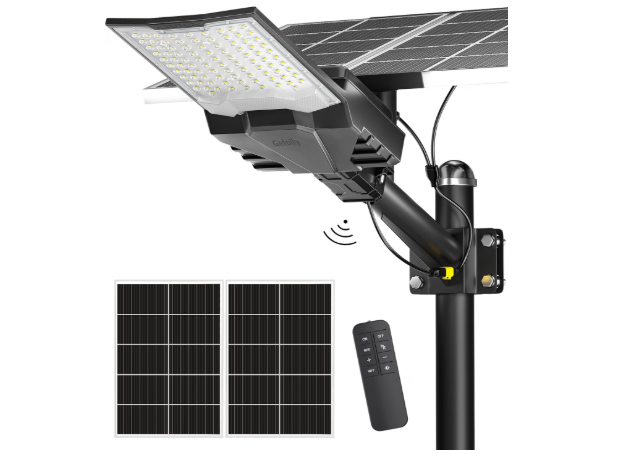
Gefolly Commercial Solar Street Light
- 60000mAh battery
- Two solar panels
- IP67 rated housing
For Easy No-Wire Setups
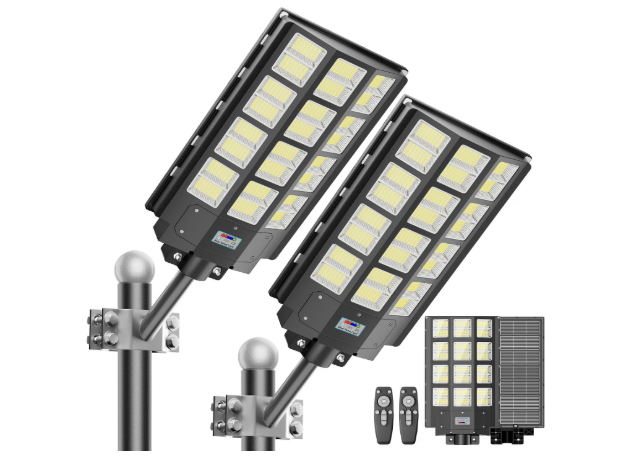
XMPTYN Solar Street Light
- 768 LEDs
- Auto light sensor
- Remote and mounting kit
How We Chose These Arena Lighting Picks
Every light on this list had to earn its spot on the details that matter in a riding space, not on headline brightness alone. Here is what we weighed for each one.
- Battery capacity and run time. A light needs enough stored power to cover a full evening session, plus some reserve for cloudy days.
- Coverage area. Wide, even light across the footing matters more than a single hot spot near the rail.
- Weather resistance. Outdoor arenas see rain, dust, and temperature swings, so we looked for clear waterproof ratings and sturdy housings.
- Control options. A remote, adjustable brightness, timers, and an always-on mode let you match the light to how you actually ride.
- Mounting flexibility. Pole and wall brackets, listed mounting heights, and no-wiring setups make it easier to place lights where the arena needs them.
We also included one hardwired option for riders who already have power near the arena and want steady output every night, regardless of the weather.
Reviews of the Five Arena Lights We Picked
1. Gefolly Commercial Solar Light for Wide Riding Arenas
This light is built around a 60000mAh battery charged by two solar panels. The listing rates it for up to 30 hours of continuous light on a full charge and a lighting area of up to 4800 square feet.
The remote switches between dusk-to-dawn and always-on modes and sets brightness from 10 to 100 percent, so you can keep output steady while you ride. Wall and pole mounting accessories come in the box, with no wiring needed.
Everyday Use Notes: The two-panel design and large battery give it more reserve for cloudy stretches than smaller single-panel lights, which suits riders who use the arena most evenings.
Standout Features:
- Dual solar panels feeding one 60000mAh battery
- Brightness adjustable from 10 to 100 percent
Main Advantages:
- Long run time for evening sessions
- Steady always-on mode while riding
- No trenching or wiring work
Works Well With:
- Poles 1.77 to 3.94 inches across
- Wall mounts on barns or sheds
- Mounting heights of 10 to 26 feet
Good To Know: The listed height range starts at 10 feet, so plan for a pole or tall wall. Keep both panels in full sun for the best charge.
2. XMPTYN Solar Street Light for No Wiring Arena Setups
Setup is the easy part here. The light comes with mounting hardware, a remote, and a manual in the box, and because it is solar powered, there is no wiring to run out to the arena.
A built-in light sensor turns it on at dusk and off at dawn, and its 768 LEDs spread light across a wide area. The waterproof and dustproof ABS housing is made for outdoor use around barns and riding spaces.
Everyday Use Notes: Owners often mention strong brightness, an easy install, wide coverage, good value, and a responsive motion sensor, while feedback on battery life is mixed.
Standout Features:
- Light sensor for automatic dusk-to-dawn operation
- 768 LEDs for broad coverage
Main Advantages:
- Quick install with included hardware
- Turns on and off by itself
- Covers large open areas
Works Well With:
- Barn walls and fence posts
- Arena perimeters and gates
- Driveways and paths to the barn
Good To Know: Battery life feedback is mixed, so expect shorter run times after cloudy days. The housing is ABS plastic rather than metal.
3. Vzyhik Solar Flood Light Set for Lighting Every Arena Side
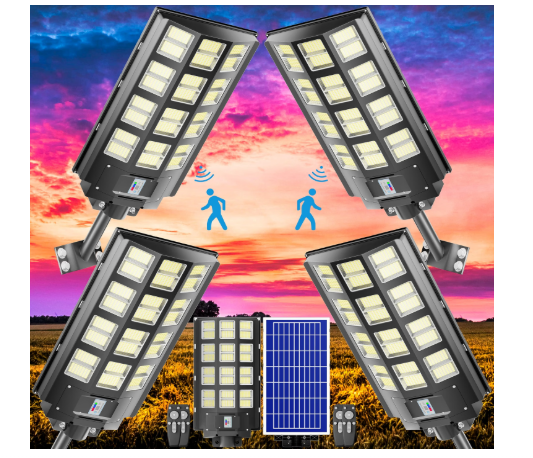
If you need light on more than one side of the arena, a four-light pack lets you cover both long sides and the gate from one purchase. Each light lists 1152 LEDs with 240 degree coverage and a lighting area of up to 3300 square feet.
A radar sensor runs the light at full brightness when people are nearby and drops to 30 percent when they leave. The remote offers four brightness levels and a timer, and a 6V 30W polycrystalline panel handles charging.
Everyday Use Notes: Owners often mention bright output, with one saying it is bright enough for safe riding, along with lights that stay on all night and dependable dusk-to-dawn and motion modes.
Standout Features:
- Radar sensor that switches between full and 30 percent brightness
- Four brightness levels with a timer on the remote
Main Advantages:
- Several lights for even overlapping coverage
- Saves battery when the arena is empty
- Stays on dusk to dawn automatically
Works Well With:
- Long arena sides and corners
- Gates and tack-up areas
- Poles or barn walls in full sun
Good To Know: The listing gives 4 to 6 hours at full output and about 36 hours in low mode. Press the light ON button before using the remote.
4. Kekeou LED Stadium Light for Arenas With Power Nearby
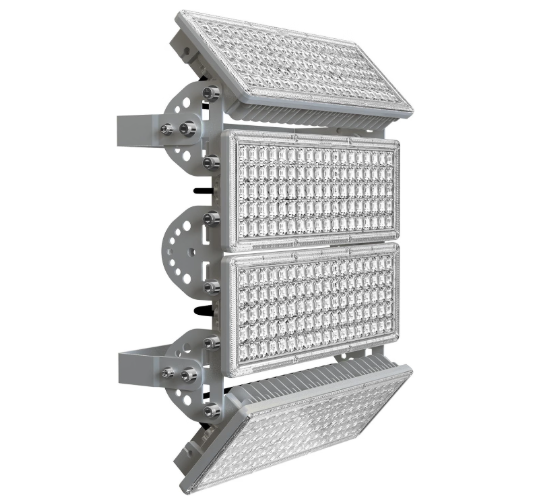
This one is different from the rest of the list because it is not solar powered. It is a hardwired AC fixture with four 100W floodlights, and it can run as a 200W or 400W setup depending on how you wire it.
The die-cast aluminum body, IP67 rating, and 10kV surge protection are built for outdoor sports areas, and each head angle adjusts so you can aim light down at the footing.
Everyday Use Notes: Because it runs on grid power, output does not depend on yesterday’s sunshine, which suits riders who train on a fixed schedule or teach lessons after dark.
Standout Features:
- Configurable as a 200W or 400W setup
- 10kV surge protection in an aluminum housing
Main Advantages:
- Same output every night
- No battery to wear out
- Aim each head where needed
Works Well With:
- Existing outdoor electrical circuits
- Weatherproof junction boxes, sold separately
- Sturdy poles or barn walls
Good To Know: It has no plug, sensor, or remote, and ships with a 1.65 ft wire. Have a licensed electrician install it on a proper outdoor circuit.
5. LANGY Solar Street Light Pair for Pens and Gates

Gates, round pens, and the path from the barn are where this pair fits well. Each light uses a 15000mAh battery that the listing rates for one to two days of continuous use in radar mode.
The remote controls modes, brightness, and a 3, 4, or 6 hour timer, and the motion sensor can either switch the light off or hold it at 30 percent when no one is around. The ABS housing is rated to work from minus 50 to 140 degrees Fahrenheit.
Everyday Use Notes: Owners often praise the light quality, while feedback on brightness, the remote, and overall function is mixed.
Standout Features:
- Motion mode that turns off or holds 30 percent brightness
- Timer with 3, 4, and 6 hour options
Main Advantages:
- Two lights for gates and paths
- Works in very cold weather
- Timer avoids lighting an empty pen
Works Well With:
- Mounting heights of 13 to 16.4 feet
- Round pens and small arenas
- Barn entries and walkways
Good To Know: A pair will not light a full-size arena alone. Feedback on brightness and the remote is mixed, so it works best as a supporting light.
Planning Coverage So Horses Never Ride Into Shadows
Start with the size and shape of your arena. A small round pen can often be lit from a couple of points, while a long rectangular arena needs lights along both long sides so the beams overlap in the middle. Light from only one side throws long shadows from the horse and rider, and those moving shadows are exactly what makes some horses jumpy.

Aim for even light rather than maximum light. Bright pools next to dark patches force your eyes to keep adjusting, and the horse sees the same contrast. Overlapping beams from several lights at moderate brightness usually work better than one very bright fixture in a corner.
Different riding work needs different amounts of light. A University of Kentucky extension guide on indoor horse spaces notes that some disciplines call for extra investment, including more lighting. Jumping and fast pattern work deserve more fixtures than a quiet walk-and-trot session, so plan for the most demanding thing you do.
Mounting Height and Spacing for Even Arena Light
Height controls how wide the light spreads and how much glare reaches your eyes. Mounted too low, a fixture shines straight into the eyes of horse and rider on each pass. Mounted higher and angled down, the same light spreads farther and stays out of direct view.
Going by the listed specifications, the Gefolly light is meant for roughly 10 to 26 feet and the LANGY lights for about 13 to 16.4 feet, so check the manual for your model before you buy poles.
Spacing comes down to overlap. Place lights so the edge of one beam reaches into the next, which avoids dark gaps along the rail. Corners and gates often need their own fixture because that is where horses turn, slow down, and sometimes balk.
The solar panel needs a clear view of the sky for most of the day. A panel shaded by a barn roof, trees, or a hill will not charge fully, no matter how good the battery is. If the best spot for the light is shaded, look for a model with a separate panel on a cable so you can mount the panel in the sun.
Solar or Hardwired Lights for Regular Night Riding
Solar lights make the most sense when running power to the arena would be expensive or awkward. There are no trenches to dig, no monthly power cost, and you can move the lights later if you change the layout. If you are weighing the bigger picture, the advantages of solar power go beyond lighting alone.
The trade-off is that solar output depends on the day before. After a string of cloudy days, a solar light may run shorter or dimmer than usual. Many models also drop to a lower brightness when no motion is detected, which saves power but can feel uneven during a long session.
Hardwired floodlights give the same output every night and suit riders who train on a fixed schedule or host lessons. They do need an electrician, a proper outdoor circuit, and weatherproof connections. Some owners mix the two, using wired lights over the main riding area and solar fixtures for gates, paths, and the tack-up area.
Keeping Batteries Charged Through Short Winter Days
Winter is when you need arena lights the most and when solar panels collect the least energy. Shorter days, a lower sun angle, and snow or frost on the panel all cut charging time. A light that runs all night in July may only cover part of the evening in December.
A few habits help. Brush snow and frost off the panels in the morning, tilt the panel toward the winter sun if the bracket allows it, and turn brightness down a step on nights you do not need full power. If you want more detail on charging without direct sun, it helps to know what actually works and what does not.
A larger battery gives you more cushion. When comparing lights, battery capacity tells you more about winter performance than the wattage figure on the box.
Motion Sensors Glare and What Horses Notice
Motion sensors save battery, but they behave differently in an arena than on a driveway. A light that waits for movement and then jumps from dim to full can startle a green horse, especially if it happens as you pass right under the fixture. For regular riding, an always-on mode or a fixed brightness level is often the calmer choice.
If you do use motion mode, mount the light so the sensor picks you up as you enter the arena rather than mid-stride. Test it at walk first so you can see how your horse reacts to the change.
Glare matters too. The responsible outdoor lighting principles shared by the U.S. Department of Energy call for directing light only where it is needed, using the least light necessary, using controls, and choosing color temperature carefully. In an arena, that means aiming fixtures down at the footing instead of out toward the horizon, which also keeps light from spilling onto neighbors.
Setup Mistakes That Leave an Arena Half Lit
Most dim or patchy arenas come down to a handful of avoidable errors.
- Lighting from one side only. It throws long shadows across the footing.
- Mounting too low. The light hits eyes instead of the ground and covers less area.
- Shaded panels. A panel under eaves or trees never charges fully.
- Skipping the first full charge. Many manuals ask you to charge the light in sun before first use.
- Leaving the switch off. Some lights ship with the main switch off, and the remote will not work until it is turned on.
- Expecting full brightness all night. Motion and dimming modes trade brightness for run time.
If a light seems dead out of the box, check the switch first. This guide on why solar lights have switches explains what that button is for.
Simple Care That Keeps Solar Lights Working
Solar lights need less attention than wired ones, but they still need some care. Arena dust settles on panels quickly, and a dirty panel charges more slowly. Wipe the panel with a soft cloth and plain water every few weeks, and more often during dry, dusty spells.
Check mounting bolts and brackets a couple of times a year, since wind and vibration can loosen them. Look for water inside the lens or cracks in the housing, and keep the remote somewhere dry. If a light starts running short or will not turn on at all, these tips on fixing lights that stop working cover the common causes.
Batteries wear out with age. If a light that used to run all night now fades early even after sunny days, the battery may be nearing the end of its life. Check the manual to see whether your model allows battery replacement.
Questions Riders Ask About Arena Solar Lighting
Are solar lights bright enough to ride under?
They can be, as long as you use enough of them and place them well. One light rarely covers a full arena, so plan on several fixtures with overlapping beams along the long sides. Look at the listed coverage area and battery capacity rather than wattage alone, since those figures say more about real output. For jumping or fast work, add extra lights at the ends and around fences so there are no dark spots where your horse has to judge distance.
How many lights does a typical outdoor arena need?
It depends on the arena size, the mounting height, and the coverage each light lists. A small round pen might work with a couple of fixtures, while a full-size dressage or jumping arena usually needs lights spaced along both long sides. Start with the coverage area on the listing, divide your arena size by that figure, and then add one or two extra lights for corners and the gate. It is easier to add a light later than to ride in shadows.
Do solar arena lights work in winter?
Yes, but expect shorter run times. Winter days are shorter and the sun sits lower, so panels collect less energy. Snow and frost on the panel stop charging altogether until they are cleared. To get the most from your lights, keep the panels clean, angle them toward the winter sun if the bracket allows, and use a lower brightness setting on nights you do not need full output. A light with a larger battery will handle winter better than a smaller one.
Will motion sensor lights spook my horse?
Some horses notice a light jumping from dim to bright, especially young or nervous ones. You can reduce the surprise by mounting lights so they switch on as you enter the arena rather than mid-ride, or by using an always-on mode during sessions. Introduce the lights at a walk first and watch how your horse reacts. Most horses settle once the lighting pattern becomes familiar, but steady light is usually the calmer option for regular riding.
Can I install arena solar lights without an electrician?
Most solar models are built for owner installation, since they need no wiring. You mount the light and panel on a pole or wall with the included hardware, aim it, and switch it on. The main jobs are getting the height right and setting poles securely, which may need help or equipment for taller mounts. Hardwired floodlights are different and should be installed by a licensed electrician with a proper outdoor circuit and weatherproof connections.
Which Light We Would Hang First
A well-lit arena comes down to even coverage, a battery that lasts through your session, and lights mounted high enough to keep glare out of your eyes. Plan the layout around your longest sides, give the panels full sun, and pick the control mode that keeps your horse relaxed.
If you want one light to start with, the Gefolly Commercial Solar Street Light is our overall pick. Its large battery, two solar panels, IP67 rating, and wide listed coverage area give you the most room to work with on short winter evenings, and the remote with an always-on mode keeps the light steady while you ride.