Disclosure: As an Amazon Associate, I earn from qualifying purchases. Learn more
Last Updated on November 6, 2026 by Mark Jase
For most garages and workshops, a ceiling-mounted 240V fan-forced heater with a digital thermostat is the safest all-around pick, and infrared units suit quieter, well-insulated rooms. Cold hands make careless cuts.
Maybe you put off a project all of last winter because the shop felt like a walk-in freezer. Now you are looking at heaters that range from a few thousand watts to well over ten thousand, and each one needs a different circuit. Buy too small and the room never warms up. Buy too big and you may be paying an electrician to upgrade your panel.
This guide helps you match a heater to your square footage, your electrical service, and the way you actually work, so you end up with steady warmth instead of a heater that trips the breaker or roars all day.
The InoKraft Electric Garage Heater brings plug-in 240V setup and ECO mode, while the Dr. Infrared Heater DR-975 offers hardwired heat with adjustable louvers for workshops.
For Plug-In Garage Setups

InoKraft Electric Garage Heater
- NEMA 14-50P plug included
- Digital thermostat with ECO mode
- One to 24 hour timer
For Hardwired Workshop Heat

Dr. Infrared Heater DR-975
- Remote controlled thermostat
- Five adjustable airflow louvers
- UL and cUL listed
Best Electric Shop Heater Buying Guide for Garages and Workshops
Start with how you use the space. Someone working on a car for a few hours on Saturday needs something different from a woodworker who spends every evening at the bench.
Next, look at the room itself. Insulation, air sealing, and ceiling height decide how hard the heater has to work. A sealed, insulated two-car garage holds heat well. A drafty pole barn with a 14-foot ceiling lets it escape fast.
Then check your electrical panel before you fall for any model. Most shop heaters that can warm a full garage run on 240V and need a dedicated circuit. Knowing what your panel can support narrows the list quickly.
Finally, think about controls and safety. A digital thermostat, overheat protection, and a safety listing from a recognized testing lab matter more than extra features you will rarely use.
Top Electric Shop Heater Picks for Garages and Workshops
1. InoKraft Electric Garage Heater for Plug-In Shop Heating
If you would rather plug in than hardwire, this heater ships with an 8.2-foot power cord and a NEMA 14-50P plug, so it can connect to a matching 240V outlet. The listing rates it for spaces up to 750 square feet.
Its automatic ECO mode adjusts output to the room temperature and can shut power off when heat is not needed. You can also pick high or low manually, and five installation angles plus adjustable louvers help aim the airflow.
In-Use Impressions: Going by the listing, it runs at about 65 dB, which suits long sessions at the bench without a harsh roar.
Feature Spotlight:
- Automatic ECO mode that trims output when the room is warm
- Automatic fan delay to push out remaining heat
Core Strengths:
- Plug-in design avoids hardwiring the heater itself
- Manual high and low heat choices
- Adjustable louvers spread warmth more evenly
Suited To:
- Home garages up to about 750 square feet
- Workshops with an existing NEMA 14-50 outlet
- Wall or ceiling installs that save floor space
Before You Choose: The listing still advises installation by a professional electrician. It needs a dedicated, correctly rated 240V outlet, and large or poorly insulated shops may outgrow it.
2. Dr. Infrared Heater DR-975 Hardwired Shop Heater for Workshops
Built for steady, long-hour use, the DR-975 pairs spiral steel sheath heating elements with a large fan that spreads warm air through garages and workshops. The listing rates it for about 800 square feet.
The totally enclosed, permanently lubricated ball bearing motor is designed for minimal maintenance. A remote-controlled thermostat and timer handle daily use, and an optional external wall thermostat can be wired in if you prefer controls at the door.
In-Use Impressions: This is a no-frills cabinet heater aimed at workshops that need dependable, even airflow more than smart controls.
Feature Spotlight:
- Option to wire an external wall thermostat, sold separately
- Heavy-duty enclosed motor with low maintenance needs
Core Strengths:
- Steel front cover with five louvers to direct heat
- Wall or ceiling bracket included in the box
- Selectable 4,700W or 7,500W output on 240V
Suited To:
- Garages and workshops around 800 square feet
- Single-phase 240V hardwired circuits
- Shops wanting wall-mounted thermostat control later
Before You Choose: No power cord is included, so it must be hardwired with 8 AWG copper wire. It has a single fan speed, and hiring an electrician adds to the setup effort.
3. VEVOR Electric Garage Heater for Larger Shop Spaces

Bigger two-car and three-car garages often need more than a 7,500W heater can give, and this 10,000W unit steps up with coverage listed at about 90 square meters. Two power levels let you scale back on milder days.
The listing says its temperature control holds within about 2°F of your setting. A cold-rolled steel shell, overheat auto power-off, and an automatic fan delay round out the package, along with remote control.
In-Use Impressions: With two output levels and a remote, it fits shops where heating needs change a lot between mild and very cold days.
Feature Spotlight:
- Tight temperature control within about 2°F
- Automatic fan delay that clears residual heat
Core Strengths:
- Higher output for larger floor areas
- Sturdy SPCC cold-rolled steel housing
- Remote control for high-mounted installs
Suited To:
- Garages and workshops up to about 90 square meters
- Wall-mounted or hanging installations
- Dedicated 240V circuits on a 42A or larger breaker
Before You Choose: This is a hardwired heater that needs a breaker rated 42A or higher, so plan for an electrician. Small rooms will likely be overpowered by its output.
4. TURBRO GH15K Smart Garage Heater for Big Electric Shops

Large shops between 1,600 and 2,500 square feet are where this heater makes sense. At 15,000 watts, it is the most powerful option in this guide, built for spaces that smaller units struggle to keep warm.
You can run it from the control panel, the remote, or a WiFi connection, with a 45 to 95°F temperature range and a 1 to 12 hour timer. Adjustable louvers and mounting angles help push warmth where you work.
In-Use Impressions: It suits owners who want to check and adjust shop heat from a phone, though setup takes more electrical work than smaller heaters.
Feature Spotlight:
- WiFi control alongside the remote and built-in panel
- Highest heat output among the heaters in this guide
Core Strengths:
- Covers very large floor areas with one unit
- Auto shut-off guards against overheating
- ETL listed for safety
Suited To:
- Shops from about 1,600 to 2,500 square feet
- Ceiling or wall mounting
- Single-phase 240V service with an 80A breaker
Before You Choose: It requires an 80A or larger breaker and 4 AWG copper wire rated at 167°F, installed by a licensed electrician. No cord is included, and it weighs over 40 pounds.
Who an Electric Shop Heater Suits and Who Should Skip
Electric shop heaters make the most sense for enclosed garages, home workshops, and hobby rooms. They produce no combustion fumes indoors, need no fuel storage, and are simple to run once installed. That makes them a good fit for mechanics, woodworkers, and garage gym users who spend regular time in one space.
They are a weaker fit in a few situations. Open-sided structures and very drafty buildings lose heat faster than most units can replace it. Older buildings with limited electrical capacity may need costly panel work first. And if you only need quick warmth at one bench for a short session, a full shop heater may be more than you need.
For a small, enclosed hobby room, a quieter plug-in option like an oil-filled radiator heater can be enough. If your main winter problem is a car that struggles to start, a magnetic engine block heater targets the engine directly instead of the whole room.
Sizing Electric Shop Heater Wattage for Small and Large Spaces
A common starting point is about 10 watts per square foot for an insulated space with a standard 8-foot ceiling. By that rough rule, a 500-square-foot garage would need around 5,000 watts.
Adjust up from there for real-world conditions. Poor insulation, a tall ceiling, frequent door openings, or a very cold climate all push the number higher. A well-sealed, insulated room may need less.
| Space | Typical approach |
|---|---|
| Small garage or hobby room | One wall or ceiling unit, lower output |
| Two-car garage | One ceiling unit, mid-range output |
| Large or tall workshop | Higher output or two units |
| Poorly insulated building | Insulate first, then size up |
In bigger shops, two smaller heaters placed at opposite ends often spread warmth more evenly than one large unit blowing from a single corner.
Choosing Between 120V and 240V Electric Shop Heaters
A standard 120V outlet on a 15-amp circuit tops out around 1,500 watts for a plug-in heater. That is fine for spot heating a bench or a small, insulated room, but it won’t warm a typical garage on a cold day.
240V heaters deliver far more output from the same size cabinet, which is why nearly every heater meant for a full garage runs on 240V. Going by the listed specifications, every heater in this guide requires a 240V supply, either through a hardwired connection or a matching high-amp plug and outlet.
If your garage only has 120V outlets, plan for an electrician to add a 240V circuit. It is a bigger upfront step, but it is what makes whole-room shop heat practical.
Circuit, Breaker, and Plug Needs for 240V Shop Heaters
Shop heaters draw a lot of current, and the circuit has to match. You can estimate the draw with simple math: watts divided by volts equals amps. A 7,500-watt heater at 240V pulls a little over 31 amps. A 10,000-watt heater pulls about 42 amps.
Because heaters run for long stretches, circuits for them are sized with extra headroom beyond the raw amp draw. That is why a heater’s manual usually lists a specific breaker size and wire gauge. Follow those numbers exactly, and never put a shop heater on a circuit shared with tools or other appliances.
Plug-in 240V models also need the right receptacle. Each plug type has its own blade pattern, so check that the plug listed for the heater matches the outlet in your garage, or that your electrician installs one that does.
Hardwired heaters should be connected by a licensed electrician following local code. Many manufacturers list professional installation as a condition of the warranty.
Fan-Forced vs Infrared Shop Heaters for Different Work Styles
Fan-forced heaters push air across hot elements and blow it into the room. They raise the overall air temperature fairly quickly and work well when you want the whole garage comfortable. The trade-off is fan noise and dust being stirred up, which matters in a woodshop.
Infrared heaters warm people and objects in their path rather than the air first. They are usually quieter and can feel warm almost right away when you stand in front of them. They do best when aimed at a work zone and in spaces where you don’t need every corner evenly heated.
Some units combine both, using infrared elements with a fan to spread the heat. If you are leaning toward radiant heat for a smaller zone, this guide to the best infrared heater options covers more choices.
Electric Shop Heater Features That Matter in Winter
Thermostat Accuracy
A digital thermostat holds a set temperature more closely than a basic dial. That means fewer big swings, less wasted energy, and a more comfortable shop.
Adjustable Airflow
Louvers or a tilting bracket let you aim heat at the bench or the car instead of the ceiling. This matters most on ceiling-mounted units.
Timers and Remote Control
A timer lets the shop start warming before you walk in. A remote is handy when the heater is mounted high and your hands are full or dirty.
Safety Protection
Look for overheat protection, a thermal cutoff, and a sturdy metal housing. A safety listing from a recognized testing lab shows the design was checked against an established standard.
How to Install an Electric Shop Heater Safely
Mount the heater on solid framing or the ceiling joists, using the bracket and hardware that came with it. Keep the clearances the manual lists on every side, especially below and in front of the air outlet.
Fire safety officials advise keeping anything that can burn three feet away from heating equipment. In a shop, that includes lumber, rags, cardboard, sawdust piles, and anything stored on shelves near the unit.
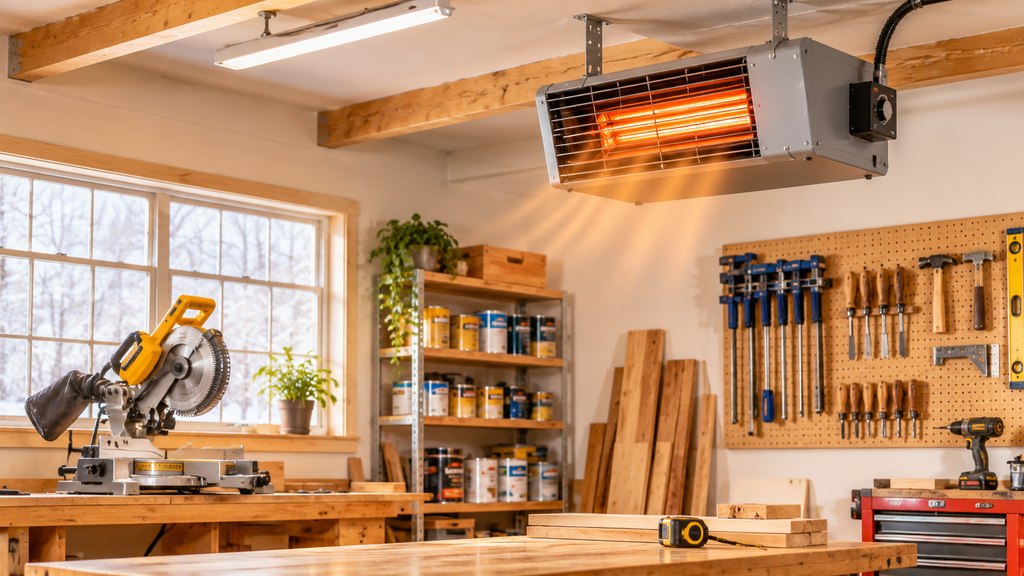
Never install or run an electric heater near gasoline, paint thinners, solvents, or aerosol sprays. Hot elements can ignite flammable vapors. Store those products in a closed cabinet away from the heater.
After installation, test the thermostat, fan, and remote before your first long session. If you notice a burning smell beyond a brief first-use odor, a tripping breaker, or a warm outlet or plug, shut the unit off and have it checked. For more on safe placement of radiant units, see this guide on radiant heater safety.
Running Costs, Thermostat Settings, and Shop Heater Care
Electric resistance heaters turn almost all the electricity they use into heat, but that does not make them cheap to run. The U.S. Department of Energy notes that electric resistance heating often costs more than heat from combustion appliances or heat pumps.
You control cost mostly through runtime and settings. Set the thermostat to a comfortable working temperature rather than the maximum. Use the timer to preheat shortly before you start instead of running the heater all day. Close doors to unused areas and seal obvious drafts.
A little care keeps the heater working well:
- Unplug or switch off power at the breaker before any cleaning.
- Clear dust from the grille and fan blades with a soft brush or compressed air, more often in a woodshop.
- Check mounting brackets and screws before each heating season.
- Look over cords, plugs, and connections for discoloration or damage.
- Keep the thermostat sensor clear so it reads the room accurately.
Common Mistakes When Buying an Electric Shop Heater
- Buying before checking the panel. A heater your circuit can’t support turns into an unexpected electrical project.
- Sizing by guesswork. Measure the floor area and factor in insulation and ceiling height before choosing wattage.
- Ignoring mounting height and clearances. A unit mounted too close to stored materials or too high to circulate well wastes heat and adds risk.
- Assuming a louder fan means more heat. Output depends on wattage, not noise.
- Skipping the safety listing. Uncertified units may not have been tested against any safety standard.
- Using extension cords or adapters. High-amp heaters need a properly rated, dedicated connection.
Questions People Ask About Electric Shop Heaters
Is it safe to leave an electric shop heater on overnight?
Fire safety guidance says portable heaters should be turned off when you leave the room or go to bed. Permanently mounted, thermostat-controlled shop heaters are built to cycle on their own, but your owner’s manual is the final word on unattended use. If you keep low background heat overnight to protect tools or supplies, keep the area clear of combustibles, make sure a smoke alarm covers the shop, and avoid running it with flammable liquids stored nearby.
What does an ETL or UL listing mean on a heater?
These marks show that a nationally recognized testing laboratory has evaluated the heater against a published safety standard. Testing covers things like electrical insulation, overheating behavior, and how the unit handles faults. A listing doesn’t mean a heater is better at warming your space, but it does mean the basic design was checked by an independent lab. Look for the mark on the product label itself, not just in the description.
Can I use an electric shop heater around sawdust?
You can, but you need to manage the dust. Fine sawdust can settle on the heater’s grille and elements, where it can scorch, smell, and in heavy amounts become a fire risk. Mount the heater away from your main cutting and sanding areas, run dust collection when you work, and clean the grille often during heavy use. Never let sawdust pile up below or around the unit.
Can a shop heater help glue, paint, or finishes cure?
A warmer shop can help, because many glues, paints, and finishes list a minimum application or curing temperature on the label. Check that number and keep the room above it for the full curing time, not just while you apply the product. Keep in mind that many finishes give off flammable vapors as they dry, so keep the heater well away from the work and follow the product’s ventilation instructions.
Can I plug a 240V shop heater into a dryer outlet?
Only if the heater’s plug and the outlet are an exact match and the circuit meets the heater’s rated amperage. Dryer outlets come in different styles, and many heaters use a different plug type. Never use an adapter or cut and swap a plug to make it fit, since that can overload the wiring and may void the warranty. If the match isn’t exact, have an electrician add a proper outlet for the heater.
Making the Right Call on a Shop Heater
The right electric shop heater fits three things at once: the size of your space, the circuit your panel can supply, and the way you work. Fan-forced units suit whole-garage warmth, while infrared units shine when you want quiet heat aimed at a work zone.
If you are still unsure, use a simple rule. Measure the room, start near 10 watts per square foot, adjust for insulation and ceiling height, and confirm the circuit with an electrician before you buy. Keep combustibles and solvents away from the heater, and it can carry your shop comfortably through many winters.